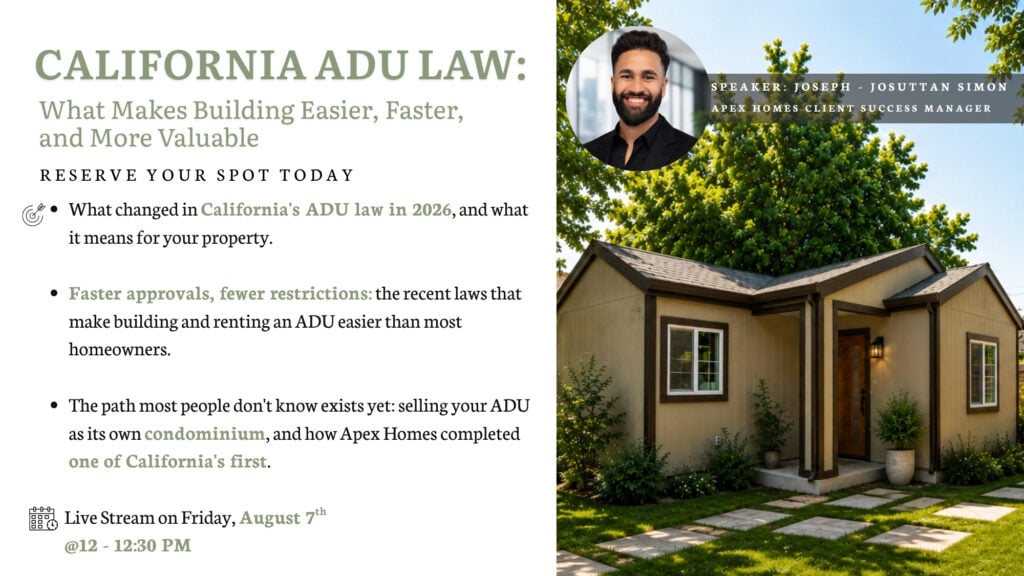
California has changed ADU law more in the last few years than in the decade before. In this webinar, Apex Homes Client Success Manager Joseph-Josuttan Simon walks through what changed in 2026, the laws that already made building easier, and the baseline rules every California property owner can still count on.
SB 543 Puts Cities on a Clock
Permitting has always been the slowest stage of an ADU project, often four to six months on its own. SB 543, effective January 2026, sets firm deadlines so an application can’t sit unread.
- Your city now has 15 business days to confirm your application is complete, then 60 days to approve or deny it.
- If the city calls your submission incomplete, you can formally appeal to the planning commission.
- ADU size is now measured by interior livable space, which can give you a little more room to work with.
- ADUs under 500 sq ft are exempt from school impact fees, which can save you thousands depending on your district.
Other 2026 Laws Worth Knowing
Three more laws took effect in 2026. Each one applies to a narrower group of owners, but they are worth checking against your property.
- AB 1154: If a junior ADU has its own private bathroom, you no longer have to live on site to rent it out.
- AB 462 and AB 818: In a declared disaster area, a detached ADU can be finaled before the main house is rebuilt, and cities must decide on those rebuild permits within 10 business days.
- SB 79: This law targets larger multifamily projects near transit. If your home sits near a major transit stop, it may still affect your land value and long-term options.
Renting and Building More Got Easier
Two earlier laws removed the biggest limits on using an ADU as an investment. Both still shape how owners plan their projects today.
- AB 976: Owner-occupancy rules for ADUs are gone for good. You can rent out the main house and the ADU and live somewhere else.
- SB 1211: On a lot that already has multiple units, you can now add up to eight detached ADUs, as long as you don’t add more ADUs than existing units.
Pre-Approved Plans in Every City
AB 1332 requires every city to offer pre-approved ADU plans. A complete application using one must be approved or denied within 30 days.
- Build the plan as approved. Structural or other major changes turn it back into a regular plan with a regular review timeline.
- Pre-approved isn’t pre-permitted. Your lot, setbacks, utilities, and any flood or geohazard zone still get their own review.
- Expect a final permit set. Engineers still prepare MEP plans, a Title 24 energy report, and load calculations before submittal.
- Pre-approved plans suit rentals and standard builds best. See how San José’s pre-approved ADU program
Selling Your ADU as a Condo
AB 1033 lets an ADU be sold separately as its own condominium in cities that opt in, so you keep the main house and the land. San José was the first city to adopt it.
- AlphaX RE Capital, through Apex Homes, completed California’s first ADU condominium conversion in San José in 2025, in partnership with the City.
- Weigh all three paths before you build: rent the ADU, sell the whole property at a higher value, or sell the ADU on its own.
- Plan for an HOA. A condo conversion needs an association between the main house and the ADU, with its own rules and fees.
- A detached ADU gets its own unit address, which keeps mail and records separate for the buyer.
Baseline Rules You Still Have
State law sets a minimum every city has to honor, and your city can be more generous on top of it. Our ADU Permit Guide lists the rules for each city we serve.
- Every city must allow at least an 800 sq ft ADU, enough for a one- or two-bedroom unit.
- State law allows a detached ADU up to 16 feet tall, and many cities allow more, up to 25 feet for two stories in some areas.
- The minimum side and rear setback is 4 feet, but walls closer than 5 feet need fire-rated construction. Building at 5 feet can save on cost.
- If your main house has fire sprinklers, your ADU will need them too. Wildfire zones and a distant fire hydrant can also require them.
Final Thoughts
California ADU law now works in the homeowner’s favor. Cities face firm permit deadlines, pre-approved plans are required everywhere, you can rent without living on site, and in some cities you can sell your ADU as a condo. How these laws apply still depends on your lot and your city, so the next step is a free consultation to see what your property qualifies for.