
Most homeowners start researching “ADU construction” and “ADU homes” thinking they’re two different searches. They’re not. Whether you call it ADU construction, an ADU home, or a backyard cottage, you’re describing the same thing: a self-contained secondary home built on a property that already has one. The terminology varies; the process doesn’t.
This guide walks through what that process actually looks like in California, and specifically in the Bay Area, where local rules add a layer most general guides skip. Here’s what we’ll cover:
- What legally counts as ADU construction, and which type we focus on
- What it costs, and what moves the number up or down
- The step-by-step timeline from first consultation to move-in
- How full-service ADU construction compares to other ways of adding a unit
- Where we build, and how to check your own lot
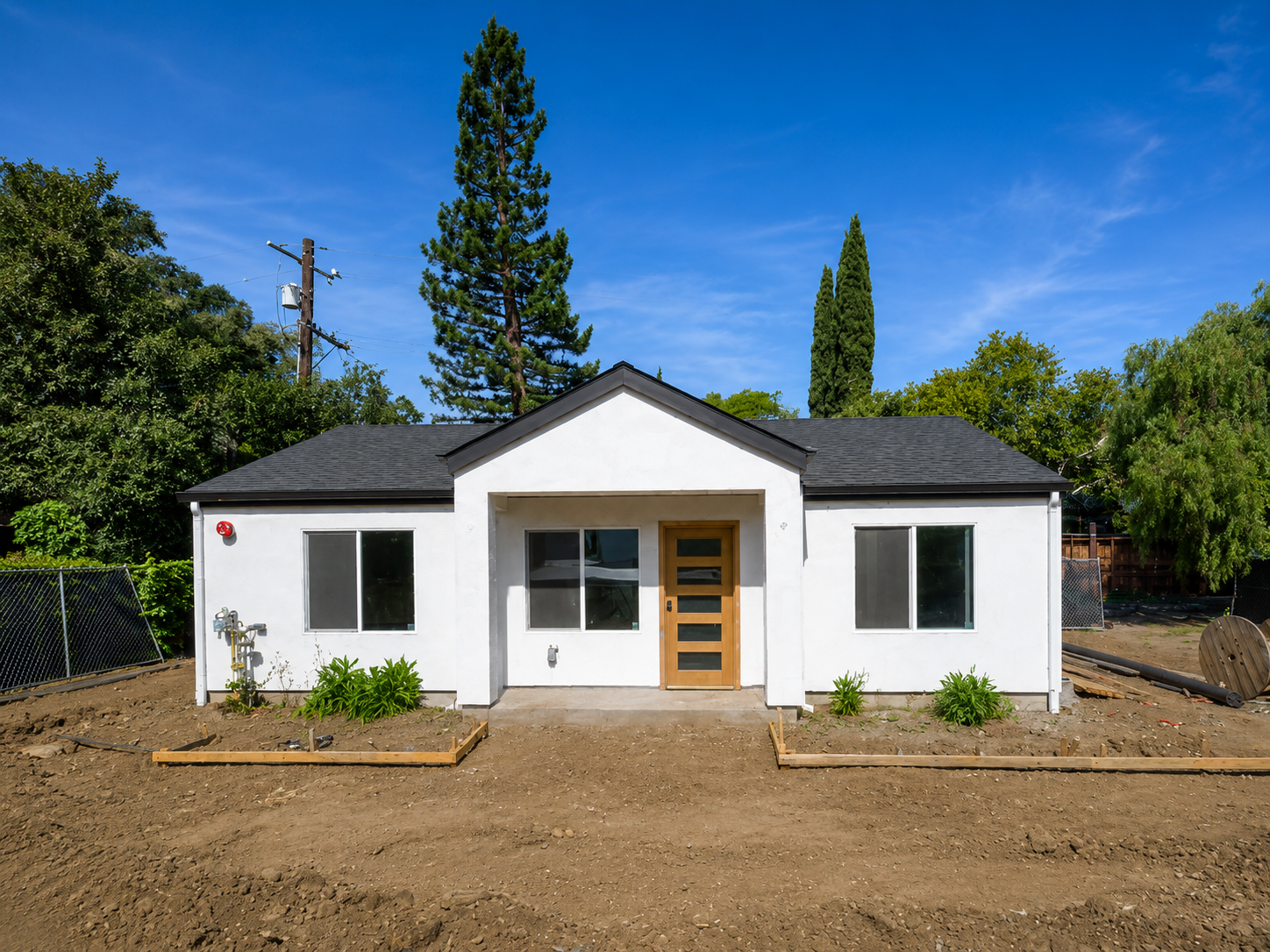
What Counts as “ADU Construction”?
California law recognizes four legally distinct types of ADU: detached, attached, garage conversion, and Junior ADU (JADU). Each comes with its own size limits, permitting requirements, and cost range. We’ve broken down all four in our Types of ADUs guide if you’re still deciding which one fits your property.
This guide focuses on ground-up detached ADU construction, a standalone structure built separately from the main house. That’s the type we specialize in, and the one most people mean when they search “ADU construction” specifically.
How Much Does ADU Construction Cost?
Across our Bay Area service area, detached ADU construction typically runs $300–$350 per square foot with one of our pre-designed floor plans. On a 750 sq ft unit, that puts most projects in the $225,000–$260,000 range before site-specific factors come into play.
A few things move that number in either direction:
- Lot preparation and soil conditions. Grading, drainage, and foundation work vary by lot, and a soil report is one of the most commonly underestimated line items in an ADU budget. We break this down further in How Much Does a Soil Report Cost for an ADU?
- Solar. We include solar panels standard on every ADU at no additional cost, which is worth asking about upfront since a lot of builders quote it as an upgrade.
- Finish level. Standard finishes are built into the base range; upgraded interior materials and appliance packages are available on any of our floor plans if you want to go further.
- City-specific requirements. Some cities apply lot-size-based sizing rules or tiered height limits that affect which floor plan actually fits your lot, which in turn affects cost. This varies enough city to city that it’s worth checking your specific address before assuming a number.
If you’re weighing cost against what an ADU could add in value, see our full breakdown of how much value an ADU adds to a home in California.
The ADU Construction Timeline, Step by Step
We run every project through the same three-stage process regardless of city: design, permit, build. The full breakdown lives on our How It Works page — here’s the short version, with the numbers that matter most if this is your first ADU.
- Design. A custom ADU layout tailored to your property, working within local size and setback limits from the start rather than redesigning after a rejected submission.
- Permit. We manage all permitting directly with your city or county. Most Bay Area jurisdictions complete ministerial review within 60 days under California’s streamlined ADU law, and our in-house team carries a 98% permit success rate across submitted projects.
- Build. Construction uses the same materials and craftsmanship standards as our full-size custom homes, on a fixed timeline, with in-house project management through final inspection and certificate of occupancy.
ADU Construction vs. Other Ways to Add a Unit
Not every path to an ADU looks like ours. Here’s how full-service ADU construction stacks up against the
alternatives:
| Design-Builder | General Contractor | Prefab Vendor | Apex Homes | |
| Manages design + permits + construction | Sometimes | Rarely | Sometimes | Always |
| Free feasibility study | Rarely | No | Sometimes | Always |
| Pre-approved design options | Sometimes | No | Yes | Yes |
| Solar included | Rarely | No | Rarely | Always |
| Transparent, itemized pricing | Sometimes | Sometimes | Sometimes | Always |
| Move-in ready interior | Sometimes | No | Sometimes | Always |
The practical difference: with a design-builder or general contractor, you’re often coordinating design, permitting, and construction as three separate relationships. A prefab vendor solves for construction speed but usually leaves permitting and site work to someone else. Full-service ADU construction keeps all of it under one accountable team, ours included. For a closer look at who’s actually building in the Bay Area, see our roundup of the leading ADU builders in the region.
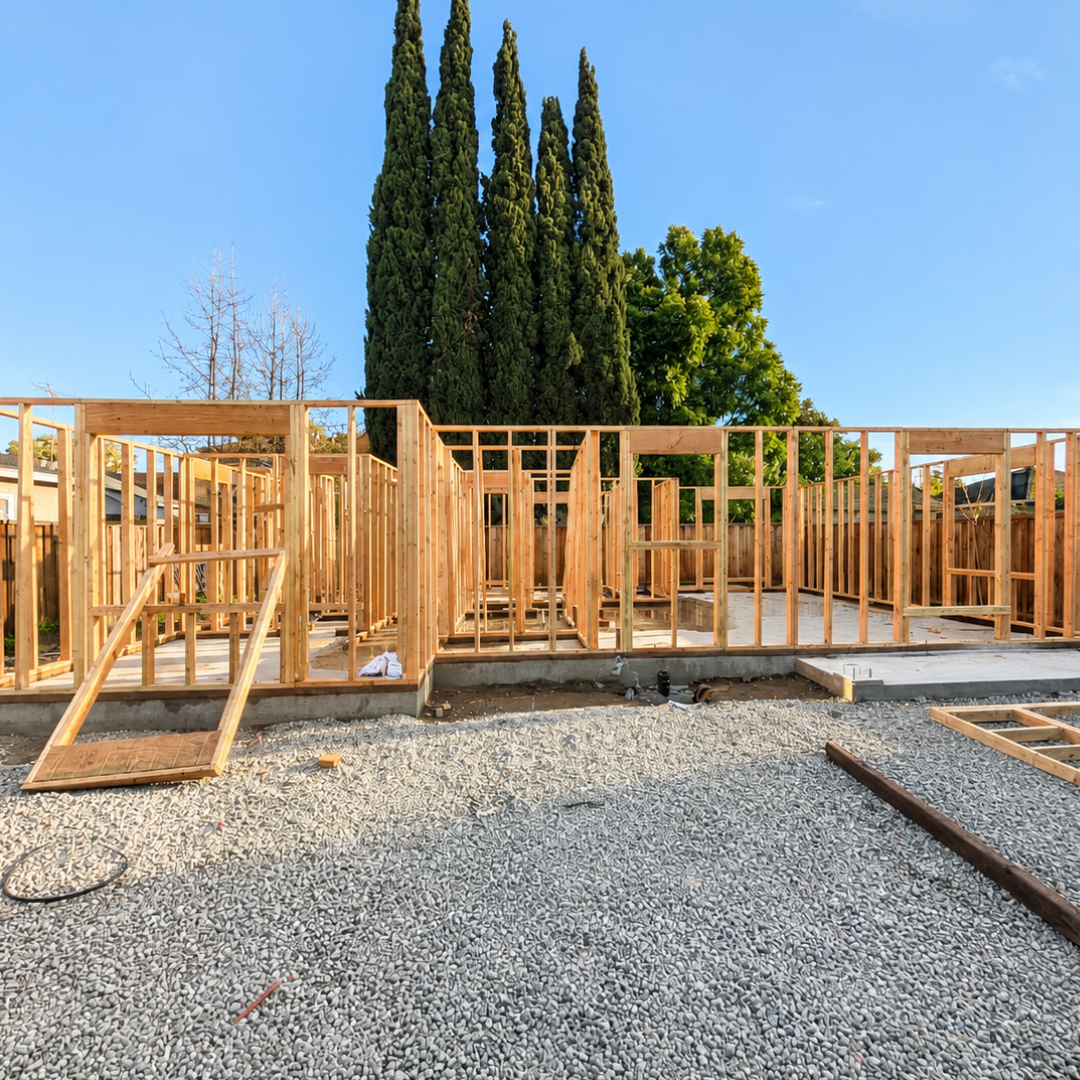
Where We Build
We build ADUs across 20+ cities in the Bay Area and Silicon Valley, including San Jose, Cupertino, Sunnyvale, Palo Alto, Santa Clara, Mountain View, Los Gatos, and Morgan Hill, among others. See the full list of service areas to find your city’s specific rules on sizing, setbacks, and permitting.
Check Your Lot’s ADU Construction Potential
Before you get into floor plans or budgets, it’s worth knowing what your specific lot can actually support. Our free ParcelZ tool takes a single address and returns buildable area, eligibility, and matching floor plans in under 60 seconds, no signup required. Pair that with our ROI Calculator to see what a unit could realistically generate in rental income before you commit to a design.
A Real Example: The San José AB1033 Project
Most ADU construction ends with a rental unit or in-law suite. In partnership with the City of San José, we completed California’s first ADU condominium conversion using AB1033, allowing an ADU to be sold as a separately owned home rather than only rented. It’s a preview of where ADU construction is headed as a path to affordable homeownership, not just added living space. Read the full case study.
Getting Started
ADU construction is a multi-step, heavily regulated process, and each step, design, permitting, construction, comes with its own local variables depending on your city. The value of working with a full-service builder is collapsing all of that into one accountable team, with transparent pricing and a track record that includes a 98% permit success rate and solar included standard, not upsold. If you’re ready to see what your property can support, get your free ADU feasibility estimate to start.