
You’ve done the math on square footage. You’ve walked the backyard and pictured where the door would go. You’re sold on the idea that an accessory dwelling unit (ADU) makes sense for your property.
Now comes the question that trips up almost every Bay Area homeowner at this stage: how do you actually pay for it?
After reading this article, you will learn more about:
- Which financing option actually fits your equity and rate situation
- A realistic sense of what an ADU costs in the Bay Area, and how rental income can offset the payment, and
- How to avoid the redesign-and-requalify cycle that trips up most homeowners
What is ADU Financing?
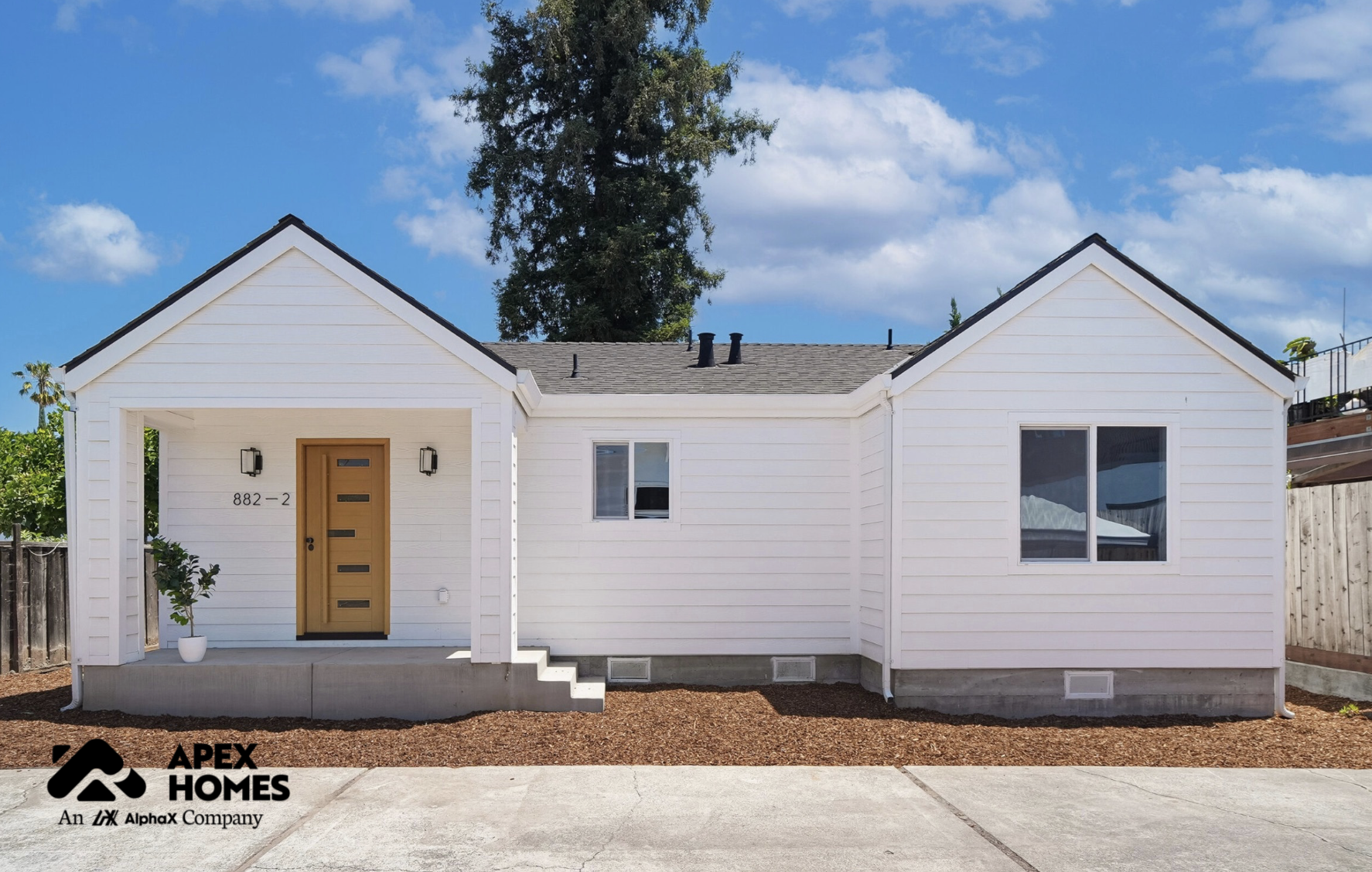
ADU financing is how you fund the design, permitting, and construction of your ADU. That means drawing on one of a few sources: the equity you’ve built in your home, a dedicated construction loan, or a refinance that folds the project into your existing mortgage.
Each path covers the same basic costs, plans, permits, materials, labor, but differs in how funds are disbursed, what rate you pay, and how much equity or income you need to qualify.
Your financing choice also sets your budget. The loan amount you qualify for is the real ceiling on what you can build, which is why it’s worth pinning down early rather than after your plans are already drawn.
If you design first and figure out the money later, you risk spending $10,000 to $15,000 or more on stamped drawings, only to learn you qualify for a loan thousands short of the design you paid for. At that point you’re redesigning a smaller unit, eating the cost of the original plans, and restarting the permitting clock.
The fix: get a realistic sense of your build cost and financing capacity before you commission custom drawings.
Builders who work from pre-approved, pre-priced plans, like Apex Homes does, let you lock in a known cost range before you ever talk to a lender, so your conversation runs on real numbers instead of guesses.
Comparing Your ADU Financing Options
There isn’t a single best way to finance an ADU. But there’s a best option for your equity position, your current mortgage rate, and what you plan to do with the finished unit.
Here’s how the main paths stack up:
HELOC (Home Equity Line of Credit)
A HELOC for ADU projects works like a revolving credit line secured against your home. You’re approved for a maximum amount, then draw funds as needed rather than taking a lump sum upfront.
Most HELOCs have a draw period, often ten years, during which you pay interest only on what you’ve borrowed, keeping monthly payments low while construction is underway.
Lenders typically want at least 15% to 20% equity remaining after the line is opened, with a combined loan-to-value ratio under 80% to 90%. Rates are variable and tend to track the prime rate plus a lender margin, so your payment can shift over the draw period.
A HELOC is generally the best fit if you have a low rate on your first mortgage and don’t want to disturb it, since it sits as a second lien and leaves your original mortgage untouched. The tradeoff is rate risk: if benchmark rates climb mid-project, your payments climb with them.
Cash-Out Refinance
A cash-out refinance ADU strategy replaces your entire existing mortgage with a new, larger one, and you receive the difference in cash at closing. Unlike a HELOC, this gives you a lump sum upfront with a fixed rate for the life of the new loan.
This makes the most sense if you can actually improve your current mortgage rate, or you’d rather have one predictable payment instead of juggling a primary mortgage and a second lien.
It’s a poor fit if your existing rate sits well below today’s market average, since refinancing means giving that rate up entirely, restarting your amortization schedule, and paying closing costs that typically run 2% to 5% of the loan amount.
Construction Loan (Construction-to-Permanent)
An ADU construction loan disburses funds in stages tied to a detailed project budget and inspection milestones, rather than a lump sum or a line against existing equity. Once the ADU is complete, the loan converts into a permanent mortgage.
This path works best for larger detached ADU projects, or homeowners without enough standing equity for a HELOC or cash-out refinance, since construction loans are often underwritten partly against the home’s projected post-ADU value.
Their milestone-based structure pairs naturally with builders who bill in phases, so your draws and your payment obligations line up instead of fighting each other.
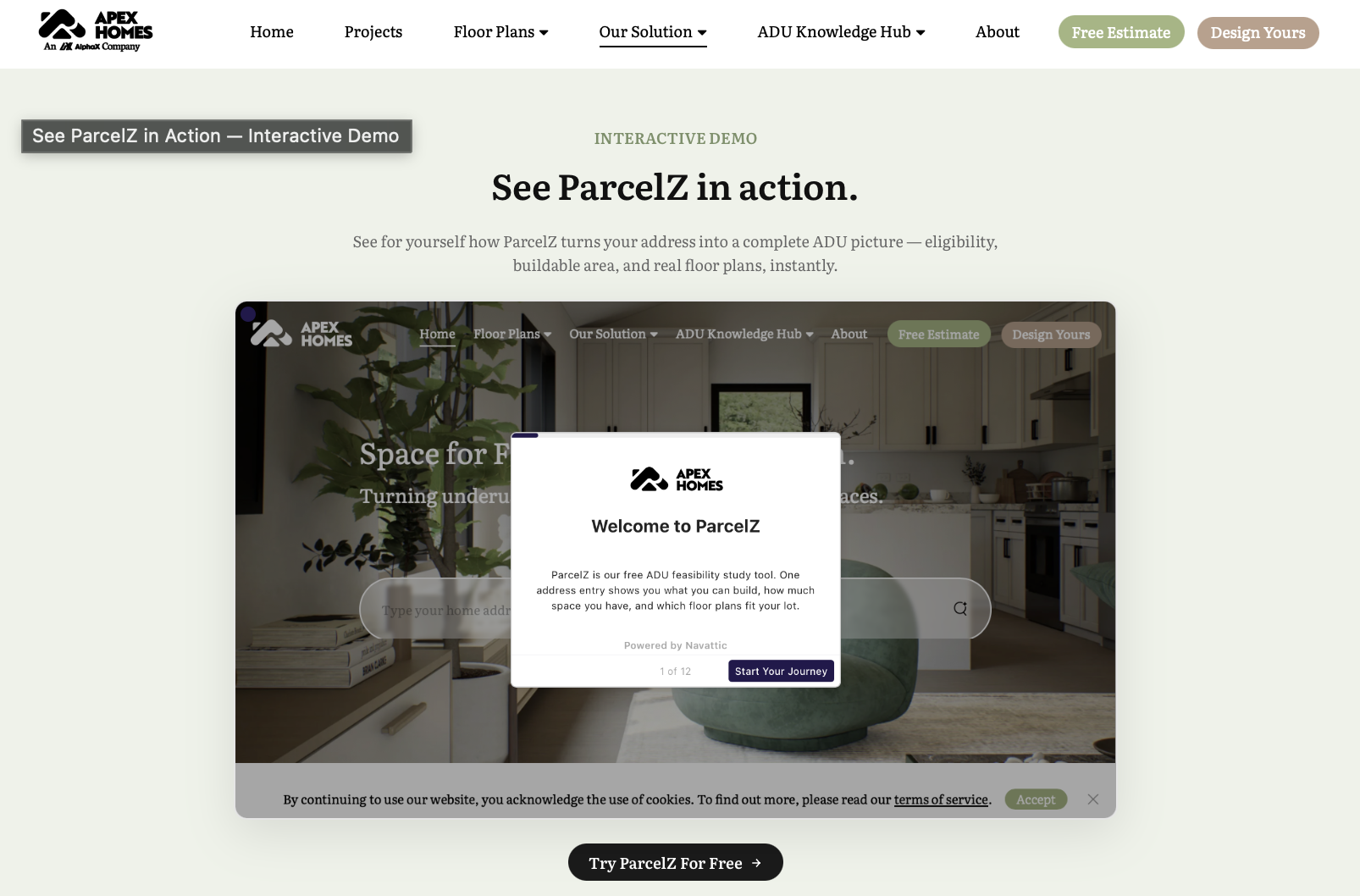
It is ideal to get a free feasibility study before you start ADU construction and talk to a lender.
DSCR Loans and After-Completed-Value Options
Two more products come up often enough to flag briefly. A Debt-Service Coverage Ratio (DSCR) loan qualifies you based on the rental income the property generates rather than your personal income; this is useful once your ADU is built and rented and you want to refinance.
Meanwhile, after-completed-value products target homeowners with limited equity today but strong projected value once the ADU is finished.
Both are worth raising with your lender, since underwriting rules shift by institution and this is a conversation best had with a mortgage professional.
Which Financing Option Fits Your Situation?
Here’s a simple way to narrow down your ADU financing options: cross your equity position against your current mortgage rate.
- If you have substantial equity and a rate you’d rather not touch, a HELOC for ADU financing is usually the starting point.
- If you have equity but your current rate is at or above today’s market average, a cash-out refinance can make sense since you’re not giving anything up.
- If your equity is thin, or the project is large enough that phased underwriting fits better, a construction loan is your path.
Whichever route you choose, pay attention to how disbursements line up with a builder’s payment schedule. Most builders bill up phases, roughly a deposit, a payment at permit submission, another at groundbreaking, and further milestones through completion.
A financing product whose draws don’t match those phases can leave you covering a gap out of pocket right when the cash flow is tightest.
Contact Apex Homes today to get a fuller walkthrough of what happens between ADU planning and groundbreaking.
What Financing Actually Costs in the Bay Area?
Numbers matter more than anything else here, so here’s the honest range.
In California, the median ADU construction cost sits around $150,000, or roughly $250 per square foot, according to UC Berkeley’s Terner Center. It’s best to confirm current pricing with your builder before budgeting, since these figures shift with material and labor costs.
The number looks less intimidating when you factor in rental income. The Terner Center puts median monthly rent for a new California ADU at roughly $2,000, with Bay Area units renting closer to $2,200, a range you can see reflected in real San Jose pricing on the ground.
On a $300,000 construction loan or HELOC balance, that rent can cover a meaningful share of the monthly payment, sometimes most of it, depending on your rate and term, which is exactly why so many Bay Area homeowners treat their ADU as rental income from day one.
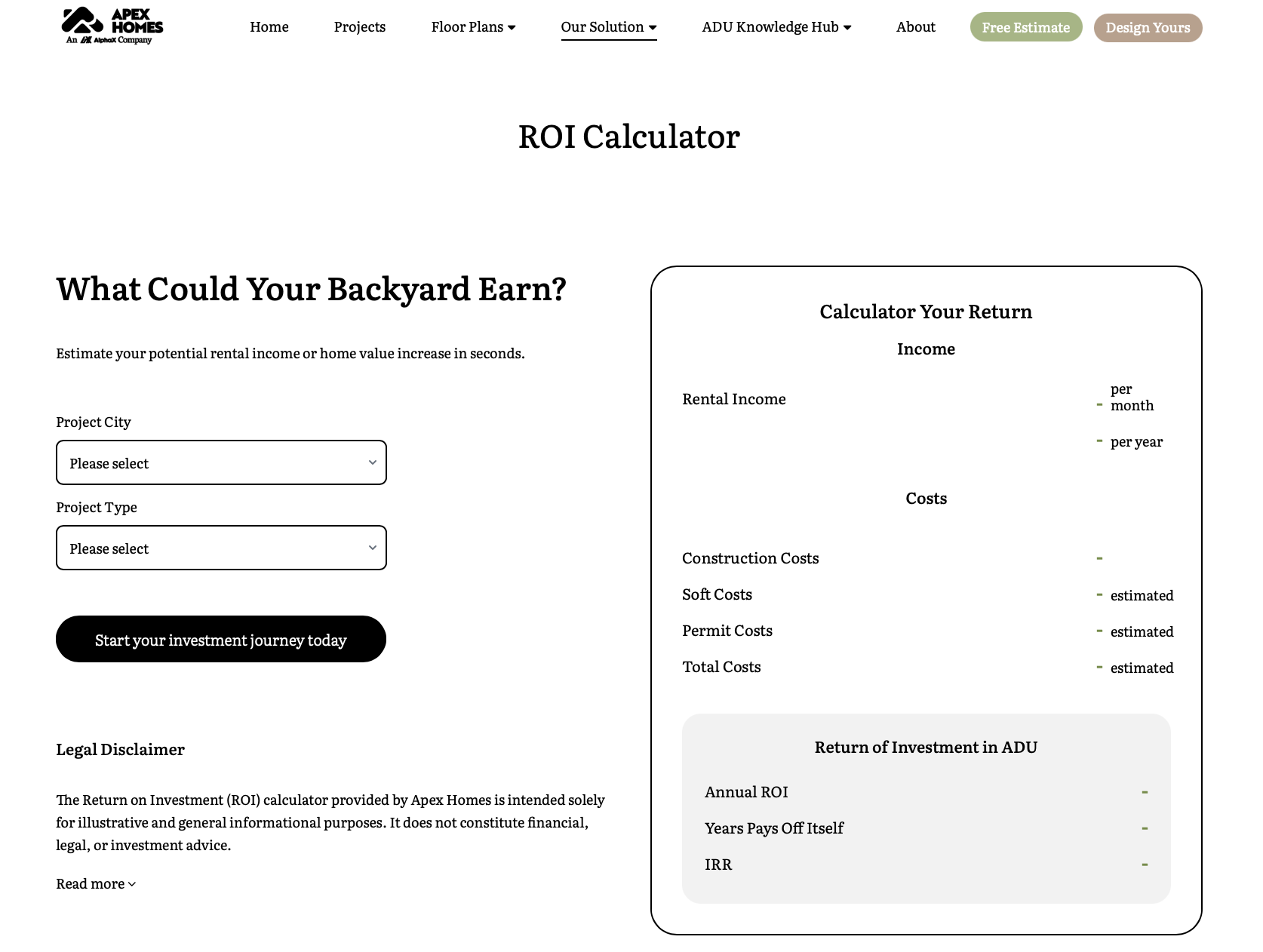
You can run your own numbers with Apex Homes’ free ROI calculator.
How to Reduce Your Financing Risk Before You Break Ground
Most of the financial risk in an ADU project happens before construction starts, not during it.
The redesign-and-requalify cycle described earlier, where a homeowner designs first, gets underwritten second, and then has to shrink the project, is the single biggest source of wasted money and delay.
The fix is sequencing. Get a real feasibility read on your lot and a realistic cost range before committing to custom drawings or a loan amount.
When your builder works from pre-approved plans and phased milestone billing, construction loan disbursements or HELOC draws can be timed to match what’s actually due at each stage, deposit, permit submission, groundbreaking, instead of guessing.
Delays cost money too. Every extra week spent waiting on permits or inspections is another week of interest accruing on a balance you’re not yet using productively.
Working with a team like Apex Homes that handles permitting in-house, rather than passing that step to a third party, tends to compress that timeline, and it protects the value an ADU adds to begin with, since a project that drags on eats into the very equity gain you’re building toward.
Ready to move past the spreadsheet stage? Get your free consultation with Apex Homes and talk through financing and design together.
Get Your Real Number, Then Talk to a Lender
There’s no universally “best” way to finance an ADU. The right answer depends on your equity, your current mortgage rate, and whether the unit will generate rental income.
A HELOC protects a low first-mortgage rate. A cash-out refinance makes sense when you can improve that rate or want one predictable payment. A construction loan fits larger builds or thinner equity positions. None of them is wrong on its own; they just fit different starting points.
What is universal is this: knowing your real build cost before you talk to a lender is what keeps you out of the redesign-and-requalify cycle that trips up most Bay Area homeowners.
Homeowners who nail down a realistic number first walk into a lender’s office with a clear ask instead of a guess, and that alone puts them ahead of most applicants. The ones who skip that step end up paying for drawings twice and losing weeks they could have spent building.
That sequence, cost first, financing second, is the single highest-leverage decision in this entire process. It costs you nothing to get right and thousands to get wrong.
Get that number first, then have the financing conversation. Book your free consultation with Apex Homes to lock in a real budget and a financing game plan you can take straight to a lender, not just more questions to sit with.