
If you’re a California homeowner, you’ve probably heard this many times: building an accessory dwelling unit (ADU) will increase your property value.
That’s true, but it’s also incomplete. The real challenge isn’t whether an ADU adds value, but how to calculate the value of an ADU accurately and realistically.
Most homeowners go into an ADU project expecting a simple percentage increase. In reality, valuation depends on multiple methods, each used by a different type of decision-maker — appraisers, lenders, buyers, and investors.
Understanding these methods is what separates a rough estimate from a defensible number.
In this article, we’ll break down:
- The three core ways ADU value is calculated in California
- How to estimate your return, and
- What factors influence how much value your unit adds
Why ADU Valuation Is More Complex Than a Simple Percentage
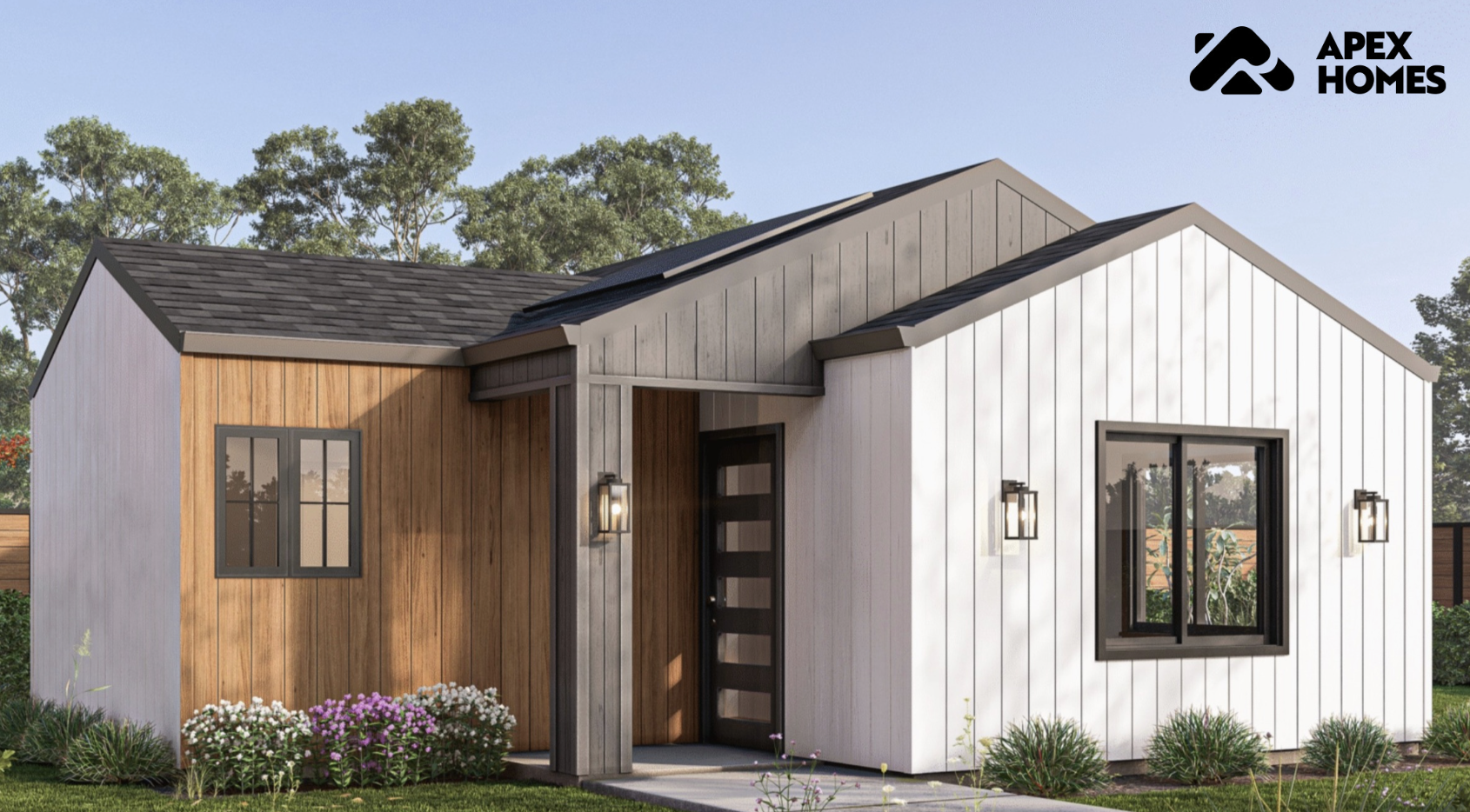
You’ve likely seen statistics claiming an accessory dwelling unit (ADU) can increase property value by up to 35%. While that figure is real, it’s not a formula you can simply apply to your unit.
That’s because value depends on who is doing the calculation, with each using different lenses:
- Appraisers determine the value for loans and refinancing.
- Buyers decide what they’re willing to pay in the market.
- Investors evaluate potential rental income.
- Lenders assess risk based on verified data.
There are three distinct ways to think about ADU value:
- Appraised value: What a licensed appraiser assigns based on data
- Market resale value: What buyers are willing to pay
- Rental investment value: What income the ADU can generate
California is unique because ADU development has surged across many jurisdictions. That means there are more comparable sales than anywhere else in the US, making valuation more accurate — and often higher — than in other states.
The Three Methods Appraisers Use to Calculate ADU Value
If you’re trying to understand how much value your ADU adds, these are the three methods that matter most.
Method 1 — The Comparable Sales Approach (Most Common)
This is the primary method appraisers use.
Here’s how it works: they analyze recent sales of similar properties with an ADU within a defined radius and time frame. These are called comparable sales.
What they evaluate:
- Square footage of both the primary dwelling unit and the ADU
- ADU type (e.g., detached ADUs, attached ADUs, garage conversion)
- ADU condition and interior finishes
- Location and neighborhood market conditions
- Whether the unit is a permitted ADU
In California, this method is especially powerful because there’s a growing dataset of ADU computations. At the time this article was written, areas like San Jose and Palo Alto had enough transactions to establish reliable pricing patterns.
Notably, here’s a common mistake homeowners fall for: combining ADU square footage with the main house and comparing it to properties without an ADU. This likely inflates expectations and leads to inaccurate estimates.
Here’s a quick example — let’s say three similar homes in your area were sold recently:
- Home A: 1,800 sq ft main dwelling + 700 sq ft detached ADU, sold for $1.9 million
- Home B: 1,750 sq ft main dwelling + 650 sq ft detached ADU, sold for $1.85 million
- Home C: 1,820 sq ft main dwelling + 720 sq ft detached ADU, sold for $1.95 million
If similar homes without an ADU are selling for around $1.5 million, the implied ADU value range is roughly $350,000 – $450,000.
That’s how appraisers isolate the contributory value.
Method 2 — The Income Approach (Best for Rental ADUs)
If your goal is to generate rental income, this method is critical. Instead of focusing on structure or square footage, the income approach values your ADU based on its earning potential.
A simple formula is as follows:
NOI / Market Capitalization Rate = ADU Value
Where:
- Net Operating Income (NOI) = annual rent less expenses
- Market Capitalization Rate = reflects market risk, which is typically 4-6% in California urban areas at the time this article was written.
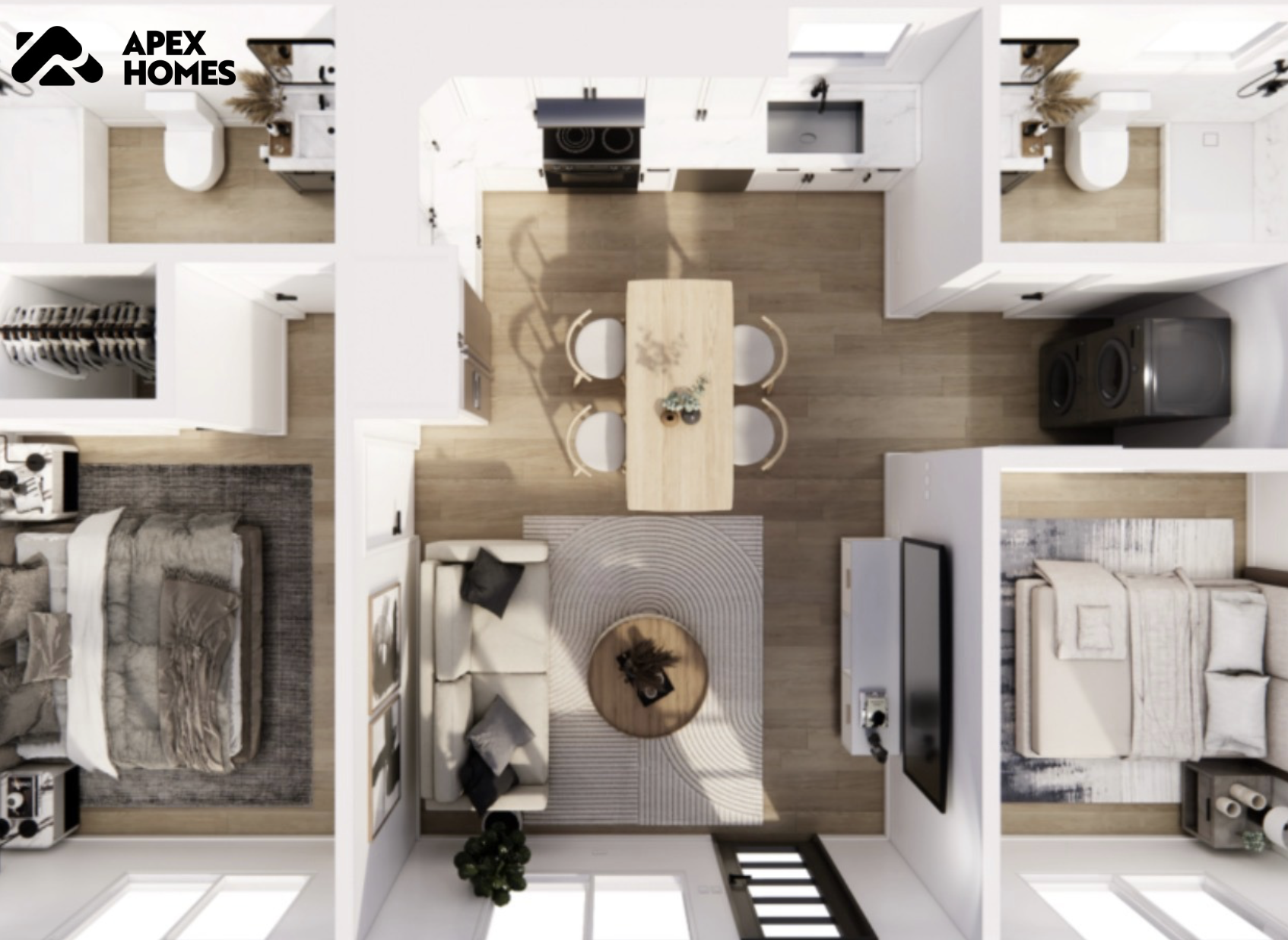
For example, you have a 746 sq ft, 2 bed/2 bath ADU that rents for $2,600 a month. With an annual rent of $31,200 and operating expenses of $5,000, the NOI is $26,200.
At a 5% cap rate:
$26,200 / 0.05 = $524,000 (estimated value)
In supply-constrained markets like the Bay Area, this method can produce higher values than comparable sales. However, appraisers typically reconcile both and lean toward the lower figure.
Method 3 — The Cost Approach (Used for New or Unique ADUs)
This method focuses on what it would cost to build or rebuild the ADU from scratch.
Here’s a simple formula:
(Land cost + New Cost) – Accumulated Depreciation = ADU value
Below are some of the included costs:
- Construction costs (labor and materials)
- Design costs and architectural plans
- Permits and permitting process fees
- Site work and utility connections
- Interior finishes
This approach is most often used when:
- The ADU is brand new.
- Comparable sales are limited.
- The ADU structure is unique.
It is important to note that cost does not always equal value. For instance, an ADU that costs $300,000 to build may not appraise at $300,000 if the market doesn’t support it.
However, a high-quality, permitted ADU with a strong design and efficient ADU size will perform better under this method because it aligns more closely with market expectations.
How to Calculate ADU ROI — Two Separate Formulas
Understanding value is one thing, but understanding return on investment (ROI) is what actually drives smart decisions.
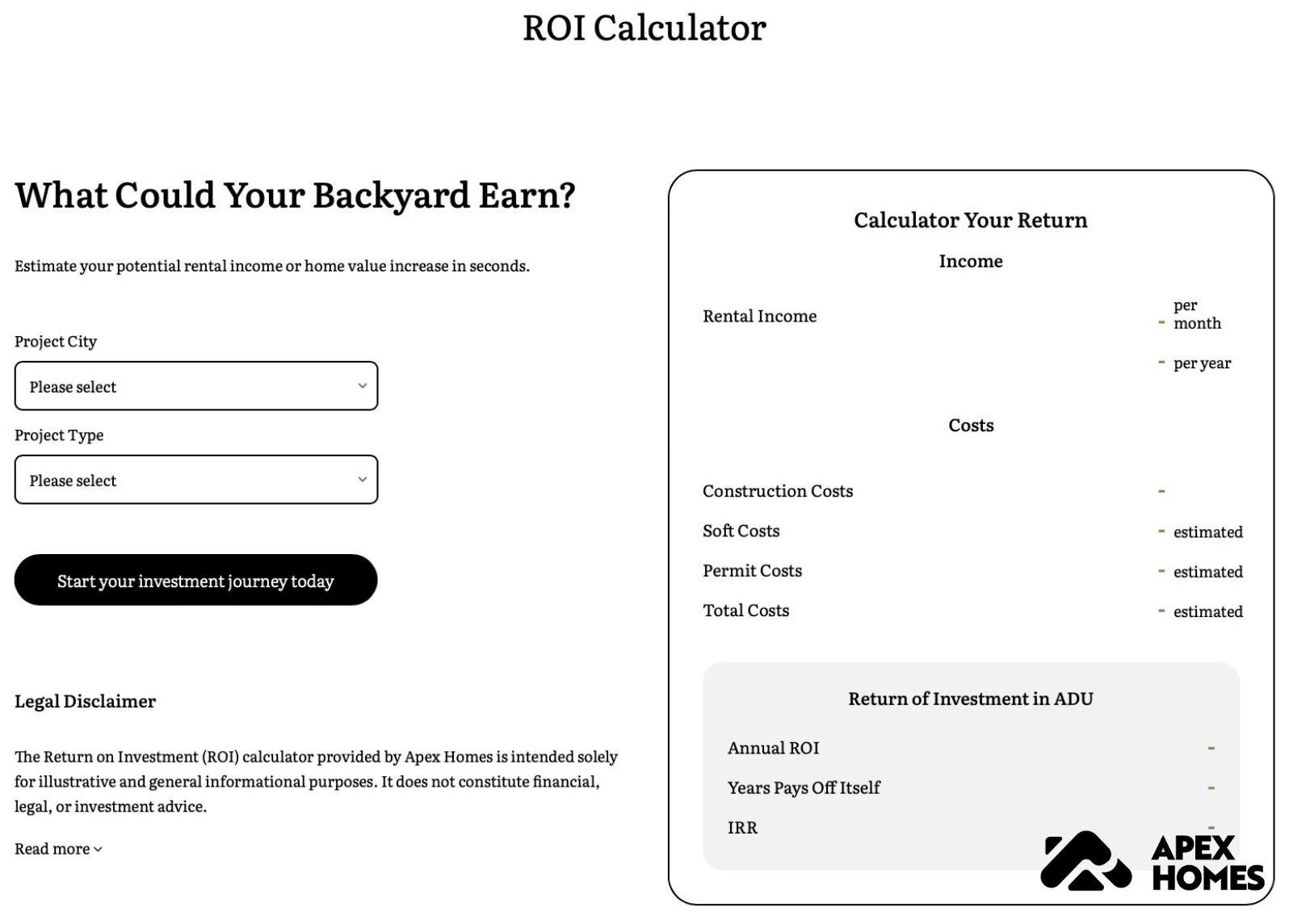
Below are two ways to evaluate ROI. You can also try Apex Homes’ ROI calculator for a more accurate computation.
Property Value ROI
This method tells you how much equity you gained relative to your investment.
Refer to the formula below:
(Property Value Increase – Build Cost) / Build Cost x 100
For example, the build cost is $268,000, and the property value increase is $350,000.
Your ROI would therefore be approximately 31%:
($350,000 – $268,000) / 268,000 x 100 = 30.6%
Rental Income ROI (Cash-on-Cash Return)
For many homeowners, the dual benefit of this method — equity gain plus rental cash flow — is what makes building an ADU a good investment.
Below is a simple formula:
Net Annual Rental Income / Total Investment Cost x 100
For example, if:
- Monthly rent: $2,600
- Annual rent: $31,200
- Expenses: $4,800
- Net income: $26,400
- Total investment cost: $268,000
The cash-on-cash return would be more than 9%:
$26,400 / $268,000 x 100 = 9.9%
The breakeven timeline would be:
$268,000 / $26,400 = 10.2 years
Key Factors That Affect How Much Your ADU Is Worth in California
Even with similar ADU costs or square footage, ADU value can vary widely. Key factors like ADU type, location, permits, and market conditions all influence how much value your accessory dwelling unit adds to your property.
ADU Type and How It’s Appraised
Not all ADUs are valued equally.
- Detached ADUs have the highest value because of the added living space and separation from the main dwelling.
- Attached ADUs have a slightly lower value since it is limited by size rules (typically, a maximum 50% of the primary residence).
- Garage conversion has a lower appraisal boost but is often more cost-effective.
- Junior ADUs have the lowest formal value but minimal construction cost
Smaller ADUs can still deliver strong returns if they generate consistent rental income.
Permits and Legality — The Single Biggest Value Driver
A permitted ADU is critical because it is:
- Recognized in appraisal and title reports.
- Fully compliant with building codes.
- Considered a legal living space.
On the other hand, unpermitted units:
- May be valued lower by appraisers.
- Are often classified as storage or non-habitable space.
- Increase lender risk.
California has streamlined the permitting process in recent years, making it easier for many homeowners to build an ADU legally.
If you’re planning to build your ADU, Apex Homes can handle the permitting process for you!
Location, Rental Demand, and Market Comparables
Location directly affected ADU value and overall property value. In strong California markets like the Bay Area, limited housing supply and high demand can significantly increase how much value an ADU adds.
Proximity to job centres, transit, and schools also boosts buyer interest and long-term appreciation.
Rental demand is also a key driver of potential rental income. Areas with a large renter population and high housing costs allow homeowners to generate rental income consistently.
This directly impacts ADU value, especially when using the rental income approach, where higher rents translate into a stronger investment and better returns.
Another factor to consider is market comparables, which appraisers rely on to estimate ADU value. Neighborhoods with more permitted ADU projects provide stronger comparable sales data, leading to more accurate appraisals.
In areas where ADU development is still growing, values may vary widely because of limited computations and less established pricing trends.
What Apex Homes Homeowners Should Know Before Their Appraisal
If you’re building with Apex Homes, you already have an advantage going into the appraisal process.
A fully permitted ADU with complete documentation — plans, permits, and construction costs — makes it easier for appraisers to assign accurate value.
To get the best outcome, make sure your appraiser understands local ADU comps, avoids combining ADU square footage with the primary dwelling, and takes both rental income and comparable sales into account.
With the right preparation, Apex Homes homeowners can present a clear, well-supported estimate of their ADU value.
Maximize Your ADU value with Apex Homes
An accessory dwelling unit is one of the most powerful ways to increase property value, generate rental income, and build long-term wealth, but only when it’s done right.
From smart ADU design to navigating permits, construction costs, and market conditions, every detail affects your final return.
Apex Homes helps homeowners build permitted, high-quality ADUs that perform across all valuation methods — whether you’re optimizing for resale, rental, or both.
If you’re ready to build an ADU and want a clear, data-backed estimate of your potential value, book a free consultation with Apex Homes today!