
Many California homeowners hesitate when it comes to adding an ADU because of one big question: Does ADU increase property tax and by how much?
It’s a valid concern. No one wants a surprise spike in their property tax bill after investing in a new secondary living space. The assumption is often that adding an accessory dwelling unit (ADU) will trigger a massive property tax increase or even a full reassessment of the entire property.
Here’s the reality: that fear is largely overstated. This guide breaks down exactly:
- How do ADU property taxes work in California
- What protections exist under state law, and
- How to estimate your own tax increase before you start building an ADU.
We’ll also connect the dots between construction costs, assessed value, and why working with a builder like Apex Homes makes your tax outcome far more predictable.
It is important to note that every situation is different. So always consult a tax professional or tax advisor before making financial decisions related to your property.
What Factors Affect How Much Your Property Taxes Increases?
When it comes to how ADUs increase property taxes, the key concept you need to understand is this: only the ADU is assessed, not your entire property. Still, not all ADUs are treated equally. Several factors determine how much your property tax increase will be.
Size and Type of ADU
The size and design of your ADU directly impact your property tax assessment.
Larger units with higher construction costs result in a higher assessed value, which leads to additional property taxes. Detached ADUs tend to have the biggest impact because they add the most square footage and independent functionality to the same property.
On the other hand, garage conversions and junior ADUs (JADUs) typically produce a much smaller tax increase. Since these projects reuse existing property structures, the added value is lower compared to building a brand-new backyard cottage or guest house.
There’s also a strategic angle here. Smaller units, like a one-bedroom ADU, often strike the best balance between increased property value and manageable tax liability.
At the same time, don’t forget the upside: larger ADUs often generate significantly more rental income and rental income potential, which can easily offset the tax increase.
Your Country’s Assessment Approach
Every county assessor in California follows state law, but the way they calculate your ADU’s assessed value can vary. Most counties base their valuation on your actual construction costs. This includes labor, materials, permits, and related expenses tied to your ADU project.
After completion, you’ll typically receive a Property Owners Declaration of New Construction form. This document asks for detailed cost information. It’s important to complete it accurately and keep records of your building permit, invoices, and contracts.
Some counties may use standardized cost-per-square-foot formulas. In some cases, this can result in a lower assessed value than your actual spend, which reduces your tax bill.
This is where Apex Homes creates a major advantage. With transparent, fixed pricing and pre-approved plans, your construction costs are clearly defined upfront. That means you can generate a rough estimate of your ADU taxes before construction even begins.
Custom builds, by contrast, often come with unpredictable costs, leading to higher and less predictable tax implications.
California Laws That Help Protect Homeowners from Larger Tax Increases
California has some of the strongest protections in the country when it comes to property taxes, adding value through improvements like ADUs. These laws are the reason why adding an ADU is often a smart investment rather than a financial burden.
Proposition 13 — Your Tax Shield
Proposition 13 is the foundation of California property taxes. Passed in 1978, it limits your property tax rate to about 1% of your assessed value and caps annual increases at 2%, regardless of market value growth.
When you build an ADU, the new unit gets its own assessed value based on construction costs. From that point forward, it benefits from the same 2% annual cap.
That means even if your property value skyrockets over time, your ADU’s property taxes remain predictable and controlled.
This is critical for long-term planning, especially for homeowners who may be thinking about rental income or housing family members, such as aging parents or adult children.
SB 1164 — The 15-Year Reassessment Delay
A common misconception is that building an ADU triggers a full reassessment of your entire property. That’s not true. SB 1164 allows eligible homeowners to delay reassessment of their ADU for up to 15 years.
To qualify, you generally need to:
- Notify your county assessor within 30 days of project completion.
- Confirm the ADU will be used as residential housing (not for business activities).
This delay can significantly reduce your short-term tax liability, giving you time to stabilize rental income or recoup construction costs.
The 2026 Update: ADUs Under 500 Sq Ft
Starting January 1, 2026, California introduced an important update affecting smaller ADUs.
Units under 500 sq ft are no longer automatically counted as fully accessible space under state law. This change could reduce the value added during your property tax assessment.
For homeowners considering compact units, this is a major opportunity to maximize added value while minimizing property tax increases. This is particularly relevant for pre-designed models like Apex Homes’ compact ADUs, which are intentionally designed to stay under key thresholds.
However, implementation can vary by local rules, so always confirm with your county tax assessor.
ADU Tax Deductions That Can Offset Your Costs
While ADUs may increase property taxes, there are also meaningful tax benefits that can offset your costs, especially if your ADU functions as a rental unit.
Depreciation Deductions for Rental ADUs
If you rent out your ADU, the IRS treats it as income-generating property. That means you can depreciate the structure over 27.5 years, reducing your taxable rental income each year.
Even if your ADU is temporarily vacant, you may still qualify for depreciation as long as it’s actively listed for rent. In addition, many related expenses may be deductible, including:
- Maintenance costs
- Insurance
- Utilities
- Property management fees
These deductions can significantly lower your income taxes and improve your overall return.
Always consult a tax professional to ensure compliance with IRS rules.
Capital Gains Shelter at Sale
One of the biggest financial advantages of adding an ADU to your primary home is the way it affects capital gains tax.
Because the ADU is part of your primary residence and not a separate investment property, you may qualify for the capital gains exclusion:
- Up to $250,000 for single filers
- Up to $500,000 for married couples
Additionally, your ADU construction costs increase your property’s tax basis. That reduces your taxable gain when you sell, and creates a powerful long-term tax benefit that many homeowners overlook when evaluating an ADU project.
Solar Tax Credit
Apex Homes includes solar in its ADU builds when required under California’s Title 24 energy standards.
This opens the door to the federal Residential Clean Energy Credit, which currently allows homeowners to claim up to 30% of eligible solar installation costs. This credit directly reduces your tax bill, making your ADU project more affordable upfront.
Know Your Numbers Before You Build
Yes, adding an ADU does increase property taxes. But here’s the part many homeowners miss: the increase is limited, predictable, and often small compared to the financial advantage.
Thanks to Proposition 13, your tax increase is capped. Thanks to SB 1164, your existing property remains protected. And with new 2026 updates, smaller ADUs may come with even lower tax implications.
At the same time, you gain:
- Increased property value
- Strong rental income potential
- Additional value for resale value
- Flexible housing for house family members
When you work with a builder like Apex Homes, you get something even more valuable: clarity.
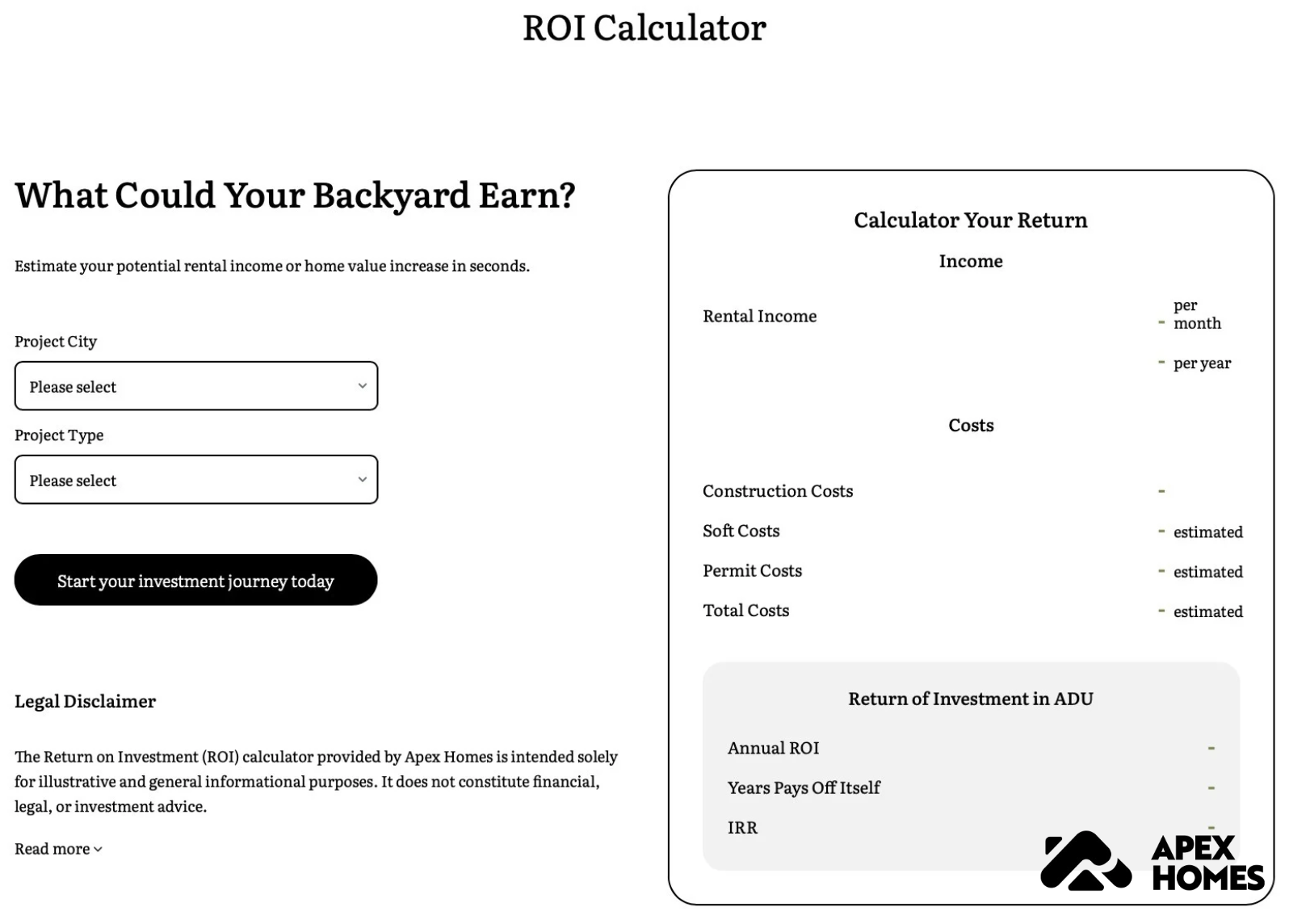
Because Apex Homes uses pre-approved plans, transparent pricing, and standardized construction costs, you can estimate your property tax increase before you build. That allows for a true one-on-one analysis of your income potential, tax liability, and long-term return.
In contrast, custom builds can often lead to unpredictable costs and unpredictable taxes.
If you’re serious about building an ADU, don’t guess. Book a free site consultation with Apex Homes and get a full financial breakdown of your project — from construction costs to projected rental income and property taxes.